Tea Packaging Pouches: Materials, Sizes
A practical guide for tea brands choosing flexible packaging — why 3-layer MET PET laminate is non-negotiable, the five pack sizes Indian retail expects, and when a stand-up zipper is worth the MOQ step.
This guide is educational, not legal or compliance advice. Regulations change; verify with the relevant authorities and your auditors before printing.
Tea is one of India’s most aroma-sensitive categories and the toughest packaging challenge in the FMCG line-up. A clean Darjeeling first flush smells like the warehouse next door if the laminate is wrong. A masala chai blend goes flat in three weeks. Getting tea packaging wrong is the easiest way to lose a repeat customer; getting it right is what separates regional brands from national ones.
This guide is for tea founders, blenders, and procurement leads working out what to ask a flexible packaging manufacturer. We will cover why tea needs a different laminate from any other dry food, the five pack sizes Indian retail expects, when a stand-up zipper is worth the MOQ step, how to plan your first run, and the compliance pieces a tea brand owns.
Why tea is the hardest category to package
Three things make tea uniquely difficult — and a fourth comes into play for blended SKUs.
Aroma volatility. Tea’s defining quality is its aroma, made of dozens of volatile organic compounds. Each one is a small molecule that diffuses through ordinary plastic film over time. A laminate that holds atta fresh for a year lets a single-estate Darjeeling lose half its aroma in twelve weeks.
Oxidation. Black, green, and white teas all oxidise differently in the bag. Oxygen reaches in, and the chemistry shifts — green tea browns, black tea flattens, catechin levels drop. A film that lets oxygen through at even a small rate compounds over months in transit and storage.
Light. UV degrades the chlorophyll in green tea and the polyphenols in everything else. A clear pouch on a shop shelf under fluorescent or sunlight is a slow kill.
Moisture (for blends). Masala chai, herbal blends, and tisanes pull in moisture once humidity gets in. The tea clumps, the dried spices lose their oils, mould risk rises.
Premium tea brands in India typically use a 3-layer PET + MET PET + LDPE structure.
The five pack sizes tea retail expects
Tea is unusual in having more pack-size variety than most dry-goods categories — from sampler sachets to bulk hotel packs.
50 g samples
Often free with a 250 g purchase, or sold in mixed-grade gift packs. Margin is low; print quality is what justifies the cost. A pre-made center-seal pouch on a 3-layer laminate works well here.
100 g (entry)
The entry SKU for new customers and online retail. Most major tea brands lead with this size. A pre-made center-seal pouch with a tear-notch, or a stand-up zipper for modern retail, is the standard.
250 g (household)
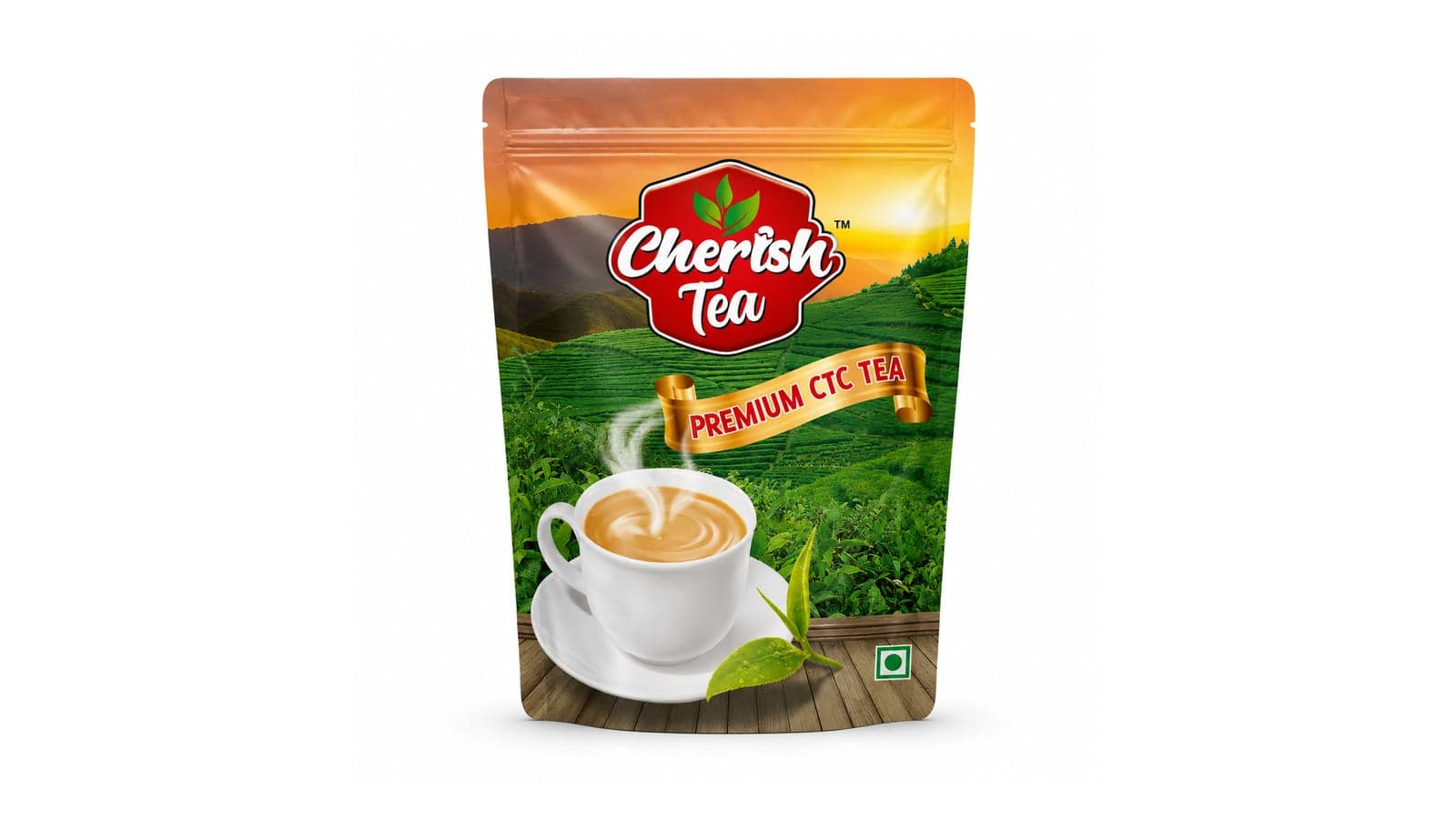
The workhorse SKU. Refill-friendly. Often sold in cartons of 12 to kirana stores. Stand-up zipper pouch in a glossy or matte finish is the default modern-trade format.
500 g (family)
For households that drink tea daily. Same format as 250 g, scaled up. Sometimes shipped in a secondary tin or pouch-in-carton for premium positioning.
1 kg (bulk and HoReCa)
For hotels, restaurants, and offices. Less retail-facing. Often a flat center-seal pouch with simple print. Stand-up zipper matters less here since the buyer transfers tea to a canister at point of use.
Why 3-layer MET PET laminate is non-negotiable
Quality-conscious tea blenders converge on one laminate structure: PET + MET PET + LDPE. Three layers, each doing a specific job.
- PET (outer) — sharp print substrate. Holds rotogravure cleanly. Resists abrasion from shop shelves.
- MET PET (middle) — metalised polyester. The aroma barrier. Reflects light. Stops oxygen transmission at a rate far better than clear films.
- LDPE (inner) — heat-seal layer. Reliable sealing temperature window. Food-safe contact surface.
Some premium brands step up to PET + aluminium foil + LDPE — actual aluminium foil instead of metalised film. Foil is denser and an even better barrier, but it is more brittle (cracks under flex) and costs more per pouch. For most Indian tea SKUs at retail price points, MET PET is the sweet spot.
Pouch formats — when each makes sense
Center-seal pouch (back-seal)
The workhorse format for tea. Sealed at the back, open at the top for filling. Used across the full size range — 50 g samples, 100 g and 250 g entry SKUs, and 1 kg HoReCa packs. See our center seal pouches and rolls.
Stand-up pouch with zipper
The premium retail format. Stands on the shelf, recloses after use, holds its shape when half-empty. Standard for 100-500 g premium retail tea. See stand-up pouches. MOQ for stand-up zipper pouches is 500 kg per design.
MET PET laminated roll for FFS
If you have a Form-Fill-Seal line in-house — common for established tea brands at higher monthly volumes — you order MET PET laminated rolls slit to your machine’s web width. Lower per-kg cost; higher upfront setup.
Print: how rotogravure changes tea brand perception
Tea is one of the most print-sensitive categories. A premium Darjeeling printed cleanly in rotogravure with a registered matt or gloss finish looks like a heritage brand; the same artwork printed flat in four-colour process looks generic.
Print elements that justify the extra colours and finishes for premium tea:
- A spot brand colour alongside CMYK + White
- Gradient leaf illustrations that need additional process colours
- A registered matt / gloss finish where the matt areas align precisely with the artwork
Rotogravure handles all of this on the same line. We can quote a single-colour generic tea pouch or a multi-colour premium pack on the same MOQ — only the cylinder count changes.
MOQ for tea packaging
MOQ depends on the format you choose.
- Laminated rolls (for FFS or pouch conversion) — 300 kg per SKU
- Pre-made center-seal pouches — 300 kg per SKU
- Stand-up zipper pouches — 500 kg per SKU
Indicative only — the formal MOQ and lead time for your order are stated in the quotation we issue.
When you are ready, the spec sheet, sizes, and starting points for your run are on our tea packaging pouch page.
Regulatory checklist for the buyer
This section is educational, not legal or compliance advice. Regulations change; verify what applies to your SKU with an FSSAI consultant, the Tea Board, and your own auditors before printing.
A few things to keep on file when you launch a tea SKU in India. These are the buyer’s responsibility — we make the packaging, you handle the compliance.
- FSSAI licence — tea is a food product. State or central licence depending on annual turnover. The licence number must be printed on the pouch.
- Tea Board of India / Tea (Marketing) Control Order — specific registrations may be required for distributors, blenders, and exporters depending on tea grade and channel. Confirm what applies to your operation with the Tea Board.
- Geographical Indication (GI) — Darjeeling, Assam, Nilgiri, Kangra teas have GI protection under the GI Act, 1999. Misuse of these origins can carry liability for everyone in the supply chain. We print what you supply; verifying the origin is your responsibility.
- Legal Metrology (Packaged Commodities) Rules, 2011 — net weight, MRP, manufacturing date, best-before date, manufacturer / packer / importer name and address, consumer-care contact.
- Nutritional information panel — FSSAI’s Labelling & Display Regulations require a nutritional declaration on most packaged food. A narrow set of exemptions exists for very small packs and specific categories; confirm what applies to your SKU with an FSSAI consultant before printing.
- Export markings — country of origin in English and destination-country language; BIS markings where required.
- Veg mark — tea is vegetarian; the green-dot symbol is mandatory.
We can position these elements on your artwork and check legibility against print specs before cylinders are engraved. Final compliance certification is between you and your auditors.
Closing
Tea packaging is the one category where the laminate spec is the brand. A clean 3-layer MET PET structure with sharp rotogravure print, in the right pouch format for your SKU size, outsells a heavier laminate that the customer never notices.
Frequently asked questions
Why does tea need a 3-layer MET PET laminate?+
Tea aroma is a mix of volatile organic compounds that diffuse through ordinary plastic films within weeks. A 3-layer PET + MET PET + LDPE laminate is designed as an aroma, oxygen, light, and moisture barrier — performance in practice depends on filling, handling, and storage at the destination.
Do I need a zipper for tea packaging?+
It depends on the SKU. For 100 g and above in modern retail, a stand-up zipper pouch is the standard — customers reclose after each use and the pouch stays presentable on the kitchen shelf. For 50 g samples or 1 kg bulk packs, a flat pouch without zipper is more economical. Stand-up zipper MOQ is 500 kg per design vs 300 kg for flat pouches and rolls (indicative — confirmed in quotation).
What is the lead time for a tea packaging order?+
Typical first-run lead time is 20–30 working days from artwork sign-off. Repeat orders are usually 10–15 working days because printing cylinders are ready with us. The formal lead time for your order is stated in the quotation we issue.