Choosing the Right Pouch for Atta Packaging in India
A practical guide for atta brands choosing flexible packaging — pack sizes, pouch formats, milky LDPE laminate, and how to plan your first run.
This guide is educational, not legal or compliance advice. Regulations change; verify with the relevant authorities and your auditors before printing.
Atta is one of the highest-volume FMCG categories in India and one of the toughest to package well. A 5 kg pack lives a rough life — stacked, shipped, lifted, dropped, and stored next to masalas that bleed moisture into anything porous. Get the packaging wrong and you have a burst pouch in the back of the kirana store. Get it right and your brand is what a customer reaches for next month.
This guide is for founders, brand managers, and procurement leads working out what to ask a flexible packaging manufacturer. We will cover the three pack sizes Indian retail expects, the pouch formats that actually work for atta, and what milky LDPE laminate gets you over a clear film.
Why atta packaging is harder than people assume
Three things make atta packaging unforgiving.
Moisture. Atta is hygroscopic — it pulls in water from humid air, and humid air in Kolkata, Mumbai, or Chennai is rarely below 70% RH from June through September. A weak laminate lets that moisture in over weeks, and the pouch starts smelling and clumping before the customer opens it.
Pests. Weevils and grain mites are present in almost every Indian warehouse. A pouch that flexes too much at the seal opens up tiny gaps over a transport cycle. The pest gets in; the customer gets a refund.
Weight. A 10 kg atta pack lives most of its life upside down in a stack. The bottom pouch carries a hundred-plus kg above it. Any seal weakness shows up six weeks after dispatch, not the day you sample the laminate.
A good atta pouch is engineered around all three. Cheaper packaging gets two of them and pretends the third does not matter.
These are the failure modes we design the laminate against. Real-world shelf-life depends on filling moisture, handling, transit, and storage at the destination; we engineer the pouch but cannot warranty the end product.
The three pack sizes Indian retail expects
Almost every atta brand we work with sells in three SKUs: 1 kg for kirana single-buyers, 5 kg for monthly households, and 10 kg for joint families and small caterers. Each has different physics.
1 kg packs
Light enough that a single bottom seal does most of the structural work. A 2-layer milky LDPE pouch is enough for most brands at this size. Print quality is your real differentiator here; you are competing on a kirana shelf where five other atta brands sit at the same eye level.
5 kg packs
The crossover size. Laminate strength becomes the main factor, not the seal — a weak film stretches and burst tests fail under stacking. Most 5 kg atta is produced either as pre-made center seal pouches for hand-fill operations, or as a laminated roll on an in-house FFS line.
10 kg packs
This is where laminate strength matters most. A 10 kg pouch is stacked, dropped, and re-stacked in transit. Most 10 kg atta uses a heavy-duty multi-layer laminate (PET + Milky LDPE for retail SKUs) for burst strength.
Pouch formats that work for atta
Two formats cover the bulk of atta production.
Center seal — pouch or roll
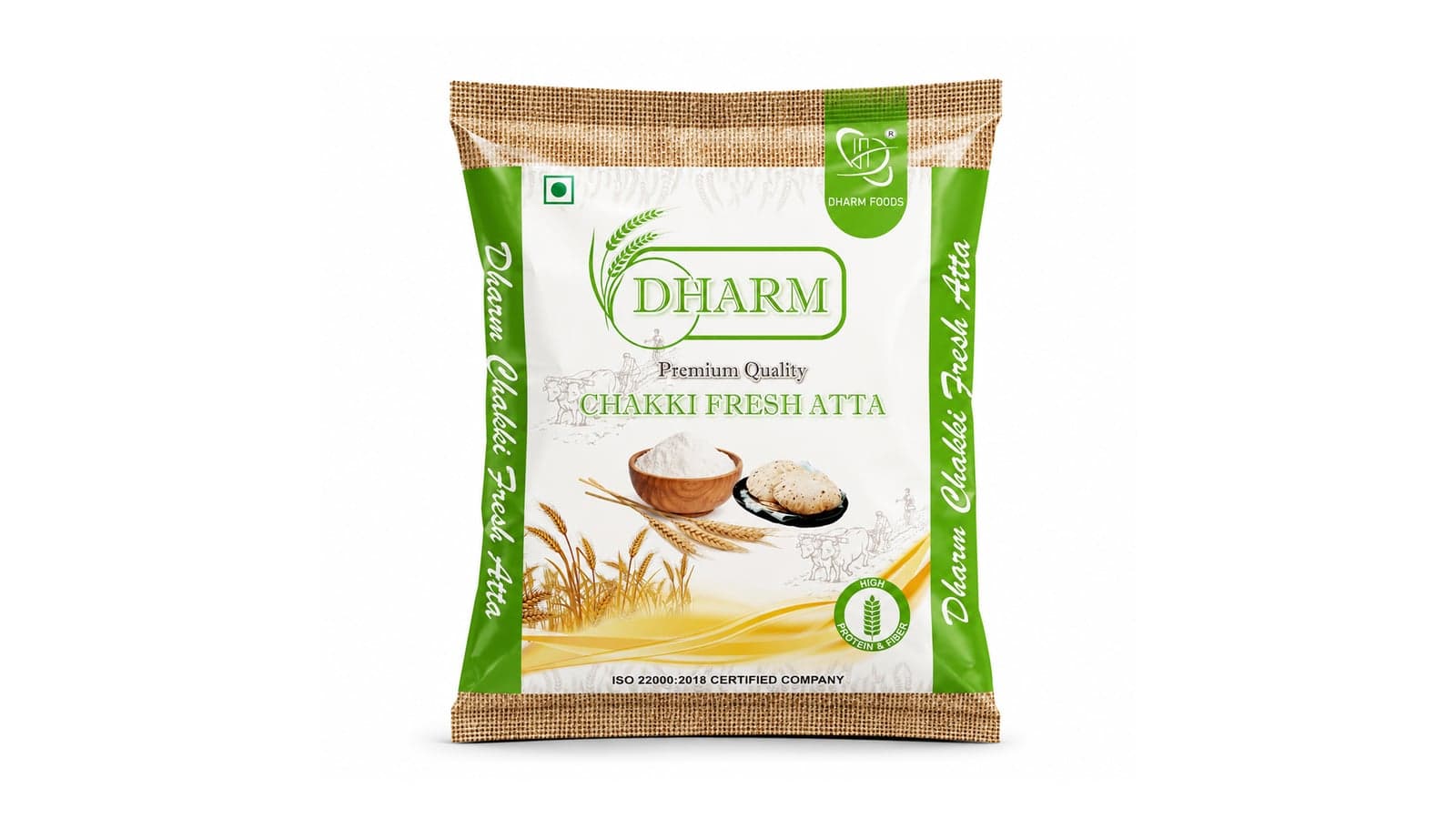
The workhorse format for atta. Available pre-made (for hand-fill and semi-auto operations) or as a laminated roll for Form-Fill-Seal machines. PET + Milky LDPE is the standard structure — milky face for clean print, PET for seal strength. See our center seal pouches and rolls.
Milky LDPE roll for FFS
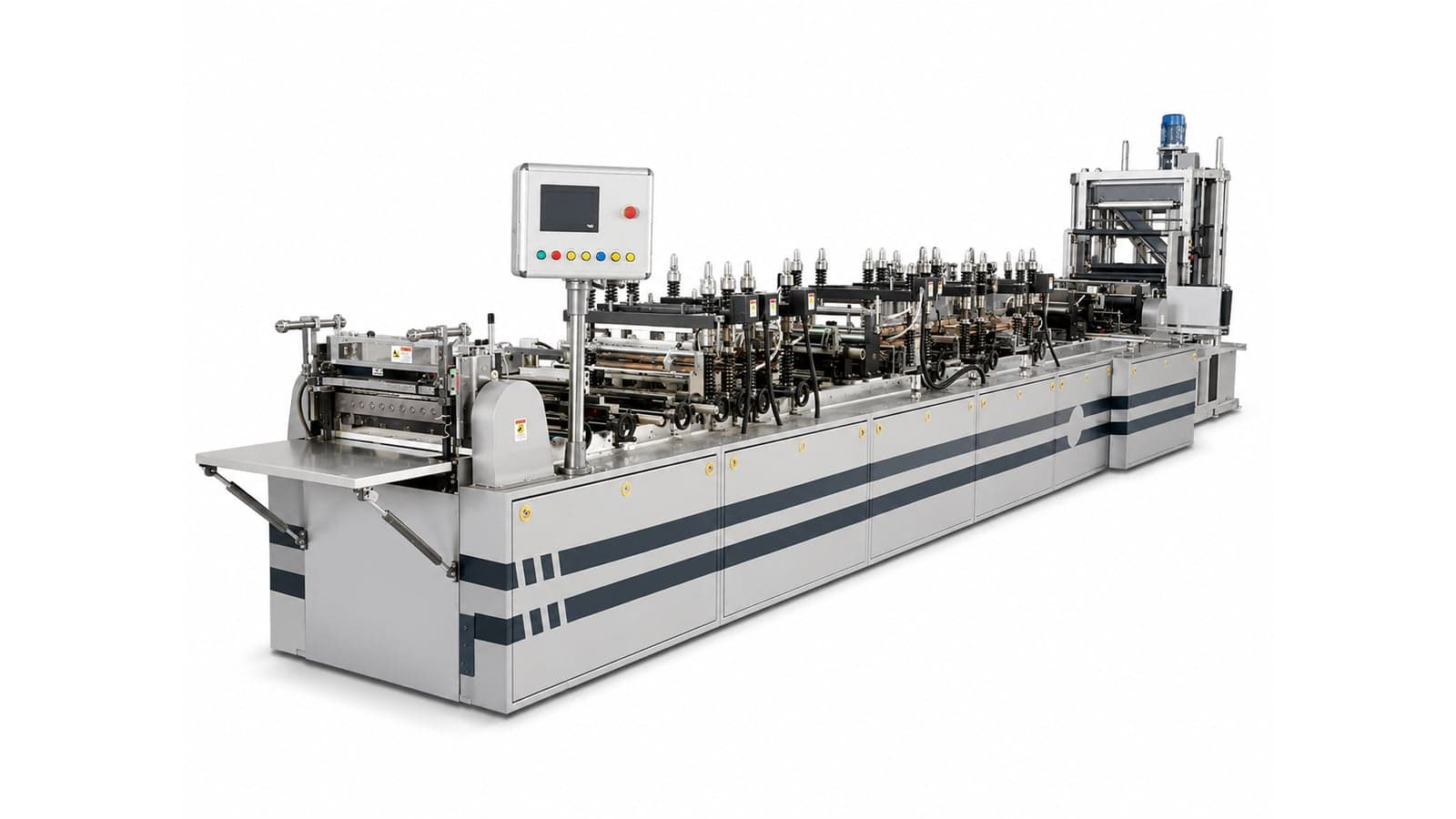
If you are running a Form-Fill-Seal machine in-house — common for atta brands at higher monthly volumes — you order a milky laminated roll slit to your machine’s web width, perforated where you need it, and printed in your brand colours. Faster line speed, lower per-kg cost, more upfront setup. Most growing atta brands graduate to FFS rolls somewhere between SKU launch year 2 and year 4.
Laminate structures: what milky LDPE gets you
The single most asked question on our quote line for atta is: why milky LDPE and not clear? Two reasons.
1. The milky layer blocks UV. Atta sitting in a shop window for a week under fluorescent light yellows in a clear pouch. The milky additive reflects most visible and UV light. Your atta looks the colour you packed it as.
2. Better print contrast. Spot colours printed on a white milky substrate hit their target values. The same inks on a clear substrate look duller because the brown of the atta bleeds through visually.
Reading a quote: what to specify when you ask a manufacturer
Most quote requests we receive say "price for atta pouch." We then send four follow-up questions. Save yourself that round-trip by specifying these seven items in your first email.
- Laminate structure — for example, 2-layer milky LDPE.
- GSM or micron — for atta, typically 60–110 micron total laminate thickness.
- Pack size — 1 kg, 5 kg, 10 kg.
- Pouch format — center-seal pouch, milky LDPE roll for FFS.
- Print — number of colours.
- Quantity — order quantity (in kg) and the estimated annual volume, so cylinder cost amortises smoothly across the year.
- Lead time you need — be specific. "ASAP" costs more than "30 days from artwork sign-off."
There is a longer version of this checklist in our buyer’s guide to flexible packaging manufacturers.
What our MOQ means in pieces for atta
MOQ depends on pack size. For packs up to 2 kg, we start at 300 kg of laminated film per SKU. For 5 kg and 10 kg packs, MOQ is 500 kg per SKU — the heavier laminate spec needs a longer run for the cylinder and machine setup to amortise correctly.
Approximate finished pouches per kg of laminate:
- 1 kg SKU — about 130 pouches per kg of laminate
- 5 kg SKU — about 25 pouches per kg of laminate
- 10 kg SKU — about 15 pouches per kg of laminate
Indicative only — the formal MOQ and lead time for your order are stated in the quotation we issue.
If you are planning a tri-SKU launch (1 kg + 5 kg + 10 kg) in one go, you would order three separate runs — one per SKU.
When you are ready, the spec sheet, gallery, and starting points for your run are on our atta packaging pouch page.
Regulatory checklist for the buyer
This section is educational, not legal or compliance advice. Regulations change; verify what applies to your SKU with an FSSAI consultant and your own auditors before printing.
A few things to keep on file when you launch an atta SKU in India. These are the buyer’s responsibility — we make the packaging, you handle the compliance.
- FSSAI licence — atta is a food product. You need an FSSAI registration (small-scale) or state/central licence depending on annual turnover. The licence number must be printed on the pouch.
- Legal Metrology (Packaged Commodities) Rules, 2011 — your pouch must display net weight, MRP, manufacturing date, best-before date, name and address of manufacturer / packer / importer, and consumer-care contact.
- Nutritional information panel — FSSAI’s Labelling & Display Regulations require a nutritional declaration on most packaged food. A narrow set of exemptions exists for very small packs and specific categories; confirm what applies to your SKU with an FSSAI consultant before printing.
- Veg mark — atta is vegetarian; the green-dot symbol is mandatory.
- BIS / export markings — if you are exporting, country-specific marks apply: country of origin, importer details, lot codes.
We can position these elements on your artwork and check legibility against print specs before cylinders are engraved. We do not certify your compliance — that is between you and your auditors — but we will not let an obviously non-compliant layout go to press.
Closing
Atta packaging is one of those categories where the spec-sheet decision and the shelf result are tightly coupled. A clean PET + Milky LDPE laminate on a center-seal pouch or FFS roll, printed sharply, outperforms a heavier multi-layer spec that the customer never notices — because the print and the format do the selling. Specify the laminate that fits your SKU rather than the laminate that fits a vendor’s margin, and the pouch pays for itself in repeat purchase.
Frequently asked questions
What’s the right laminate for 1 kg atta?+
2-layer milky LDPE is enough for most 1 kg atta SKUs sold in traditional and modern trade. The milky tint blocks UV and gives you a clean white substrate for print.
Will a laminated atta pouch keep the flour fresh?+
The laminate is designed as a barrier against moisture, light, and oxygen — the three things that age atta in storage. Real-world shelf-life depends on filling moisture, handling, transit, and storage at the destination, all of which sit outside our control.
What is the lead time on a first order?+
Typical first-run lead time is 20–30 working days from artwork sign-off. Repeat orders are usually 10–15 working days because printing cylinders are ready with us. The formal lead time for your order is stated in the quotation we issue.